Jensen Huang
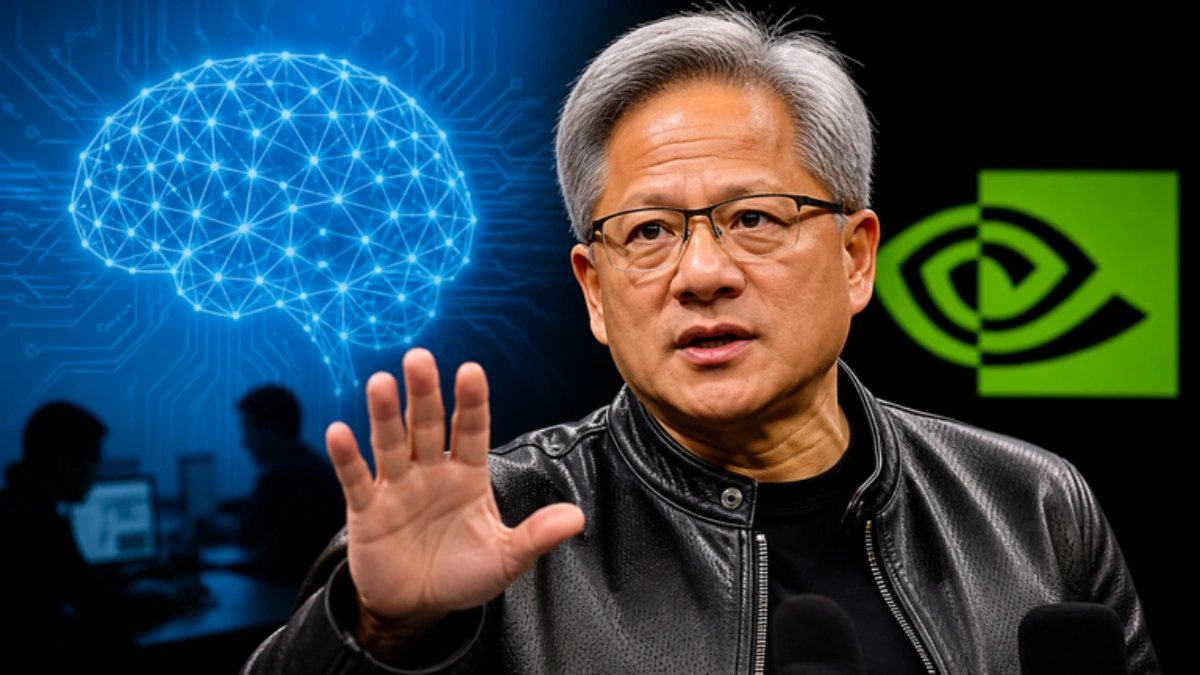
In the rapidly evolving world of artificial intelligence, bold predictions about its impact on jobs and society have become increasingly common. However, Jensen Huang, the CEO of NVIDIA, has urged caution. Speaking on the “Memos to the President” podcast, Huang emphasized that tech leaders should avoid making exaggerated or fear-driven statements about AI, especially when it comes to job losses and doomsday scenarios.
Call for Responsible Conversations on AI
Huang pointed out that while AI adoption is accelerating across industries, the conversation around its impact must remain grounded in reality. He stressed that overly dramatic claims—particularly those predicting massive unemployment or catastrophic outcomes—can mislead the public and create unnecessary fear.
According to him, discussions about AI should be based on evidence and careful analysis rather than speculation or sensationalism.
Subtle Response to Industry Predictions
Huang’s remarks appear to be a response to recent comments by Dario Amodei, CEO of Anthropic, who suggested that artificial intelligence could replace up to 50% of entry-level white-collar jobs in the future.
While Huang did not directly criticize Amodei by name, he made it clear that such sweeping predictions may reflect overconfidence rather than a complete understanding of the technology’s trajectory.
He noted that many of these statements come from top executives who may unintentionally overestimate their ability to predict the future. In a candid observation, Huang remarked that CEOs can sometimes develop what he described as a “God complex,” leading them to speak with unwarranted certainty.
“Hot Takes” Do More Harm Than Good
Huang was particularly critical of what he called “hot takes”—quick, attention-grabbing opinions that lack depth or nuance. He argued that such remarks are not helpful in shaping a balanced understanding of AI.
“These kinds of comments are not helpful,” he said, adding that leaders should be mindful of their influence and avoid spreading incomplete or exaggerated narratives.
Rejecting Extreme AI Fears
Beyond job-related concerns, Huang also addressed more extreme claims about AI posing an existential threat to humanity. His comments appeared to indirectly counter views expressed by Elon Musk, who has previously suggested there is a significant risk of AI leading to human extinction.
Huang dismissed such scenarios as unrealistic, emphasizing that fear-based narratives can distort public perception and hinder constructive dialogue about the technology.
The Future of AI Remains Uncertain
One of Huang’s key points was that the future of AI is still unfolding and cannot be predicted with absolute certainty. While AI is undoubtedly transforming industries—from healthcare and finance to manufacturing and creative fields—its long-term effects on employment and society remain complex and multifaceted.
He stressed the importance of acknowledging this uncertainty rather than presenting definitive conclusions.
A Balanced Perspective on AI
Huang’s message highlights the need for a balanced and responsible approach to discussing artificial intelligence. He acknowledged that AI has the potential to reshape the workforce and bring about significant changes, but he also warned against overstating either its risks or its benefits.
By promoting fact-based and measured conversations, Huang believes that society can better understand and adapt to the evolving role of AI.
Why This Matters
As AI continues to integrate into everyday life, public perception will play a crucial role in shaping policy decisions, business strategies, and workforce planning. Influential voices in the tech industry have the power to guide this perception, making it essential for their statements to be accurate and responsible.
Huang’s remarks serve as a reminder that while AI is a powerful and transformative technology, discussions about its future should remain grounded in reality—not driven by hype or fear.
About the Author