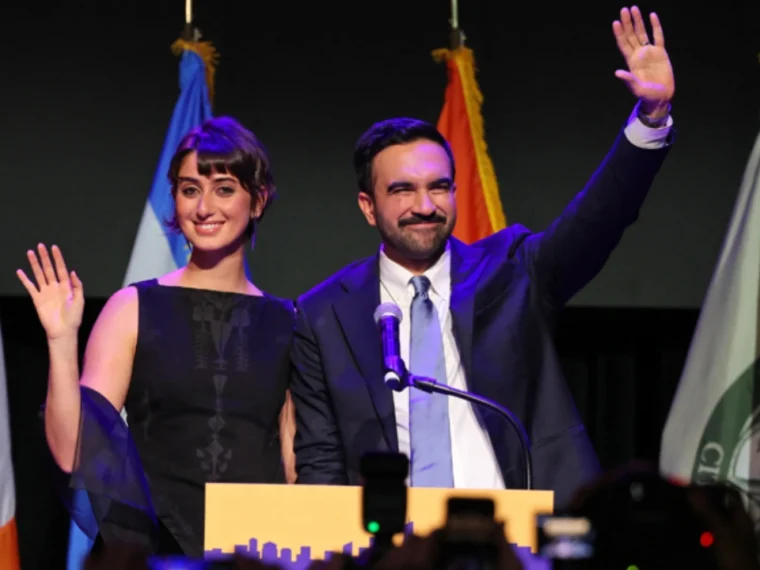
New York City Mayor Zohran Mamdani has come under fresh scrutiny after social media activity by his wife, Rama Duwaji, resurfaced online. The controversy has reignited debate about the mayor’s stance on antisemitism and his relationship with Jewish communities in New York City.
Since assuming office, Mamdani has repeatedly attempted to reassure Jewish residents that his administration would firmly oppose antisemitism. However, reports about social media posts liked by his wife following the October 7 Hamas attack on Israel have triggered intense public discussion.
Posts linked to Oct 7 attack draw attention
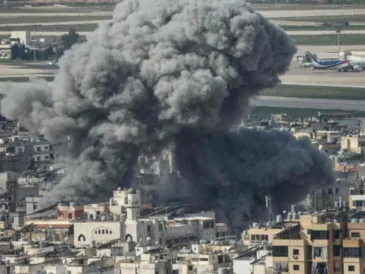
The controversy relates to posts reportedly liked by Duwaji after the October 7, 2023 attack carried out by Hamas in Israel. The assault killed around 1,200 people and resulted in the kidnapping of more than 250 hostages, most of them civilians, sparking the ongoing Israel–Hamas war.
Some social media posts circulating at the time framed the attack as an act of resistance and questioned widely reported atrocities. According to reports that resurfaced in 2026, Duwaji had liked several posts connected to those narratives, including posts that celebrated the breach of Israel’s border and questioned claims of sexual violence during the attack.
The resurfaced activity has drawn criticism from observers who argue that amplifying or endorsing such narratives risks minimising the suffering of victims.
Mamdani distances himself from the posts
When asked about the issue, Mamdani sought to distance himself from the controversy, stating that his wife is a private citizen and does not represent his administration.
However, critics say his response stopped short of directly condemning the content associated with the posts. Some observers believe a clearer denunciation of narratives surrounding the attack could have helped reassure concerned communities.
Past views on Israel under scrutiny
The debate has also revived attention on Mamdani’s own political record. Before becoming mayor, he built his reputation as a progressive activist and politician who openly supported pro-Palestinian movements.
He has been a supporter of the Boycott, Divestment and Sanctions movement (BDS), a global campaign aimed at pressuring Israel economically and culturally over its policies toward Palestinians. Many Jewish organisations criticise the movement, arguing that it unfairly targets Israel and questions the legitimacy of the world’s only Jewish state.
Mamdani has also been critical of Israeli government policies and has previously declined to recognise Israel specifically as a Jewish state, a position that continues to draw debate among political commentators and advocacy groups.
His stance during the Israel–Hamas war
During the conflict that followed the October 7 attack, Mamdani repeatedly called for a ceasefire and criticised Israel’s military operations in Gaza.
While many global leaders have voiced similar concerns, critics argue that his messaging focused more heavily on condemning Israel’s actions than on addressing the Hamas attack that triggered the war.
Supporters, on the other hand, say his comments reflect broader humanitarian concerns about the conflict.
Debate over antisemitism in New York
The controversy comes at a time when antisemitic incidents have increased in several parts of the world following the October 7 attack and the ongoing war.
As a city with one of the largest Jewish populations globally, New York City remains particularly sensitive to developments related to antisemitism and Middle East politics.
Political leaders’ statements and associations are often closely examined in this context, especially when issues involving Israel and Jewish communities arise.
A continuing political debate
Mamdani has publicly condemned antisemitic vandalism and pledged to protect Jewish communities in the city. Nevertheless, the resurfacing of his wife’s social media activity has complicated those assurances for some critics.
The episode has broadened into a larger debate about political rhetoric, social media behaviour, and how leaders respond to controversial narratives during times of global conflict.