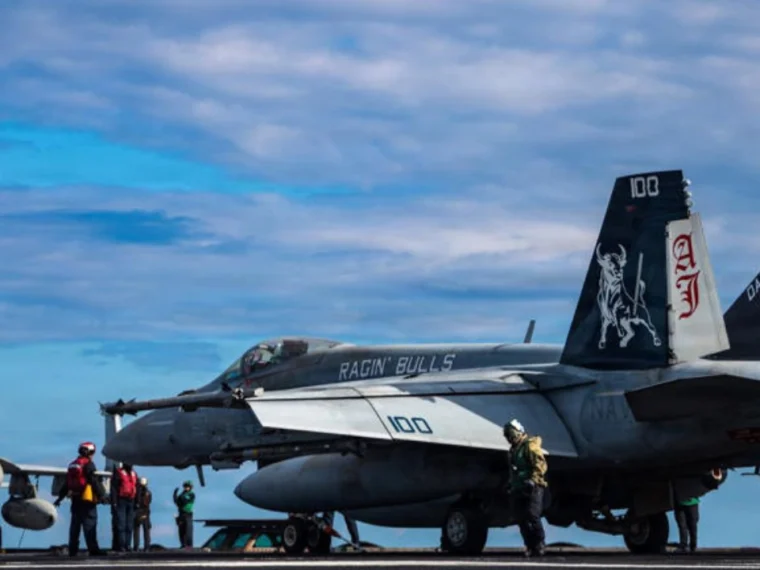
As American fighter aircraft dominate conflict skies — from carrier-based F/A-18 Super Hornet to stealth platforms like the F-22 Raptor and F-35 Lightning II — one question resurfaces: why has India never purchased American fighter jets despite buying billions of dollars’ worth of other US military hardware?
Over the past two decades, nearly every frontline US combat aircraft, including the F-16 Fighting Falcon and F-15E Strike Eagle, has reportedly been offered to India at some stage. Yet New Delhi has consistently declined.
The Cold War Legacy
To understand this pattern, one must revisit the Cold War era. During that period, the United States armed Pakistan with advanced fighter jets such as the F-86 Sabre, F-104 Starfighter and eventually the F-16. These aircraft were not symbolic transfers; they were operational platforms used in wars — including conflicts against India.
For New Delhi, the memory of American-supplied jets flying under Pakistani colours left a lasting imprint. As a result, India leaned heavily toward the Soviet Union for its air power needs. Over decades, the Indian Air Force inducted aircraft like the MiG-21, MiG-23, MiG-29 and later the Sukhoi-30MKI — which remains its backbone. Western acquisitions came from Europe instead, including the French Mirage 2000 and the Anglo-French Jaguar, but not from Washington.
The 1998 Nuclear Tests and Sanctions
Relations between India and the US improved after the Cold War, with growing economic and strategic engagement. However, in May 1998, India conducted nuclear tests. The administration of then US President Bill Clinton responded with sanctions and technology restrictions.
For India’s strategic establishment, this was a defining moment. The swift imposition of penalties reinforced concerns that US defence ties could come with political strings attached. Though relations eventually recovered — culminating in civil nuclear cooperation and deeper defence engagement — a residue of caution remained.
Buying American — But Not Fighters
Ironically, India today operates several high-value American military platforms. These include the C-17 Globemaster III heavy transport aircraft, C-130J Super Hercules tactical airlifters, P-8I Poseidon maritime patrol aircraft, Apache attack helicopters, and Chinook heavy-lift helicopters. India is also set to acquire MQ-9B Predator drones.
Despite this growing defence partnership, fighter aircraft remain the exception.
The Core Issue: Combat Autonomy
The reluctance stems from a concept deeply embedded in Indian defence planning — strategic autonomy. A fighter jet is more than a machine; it is central to sovereign air defence capability. Operating US-origin fighters could mean reliance on American spare parts, software upgrades, weapons integration approvals and export licences.
India has observed instances where Washington leveraged defence supplies for geopolitical influence. Turkey, despite being a NATO ally, faced pressure and programme suspensions over disputes involving advanced fighter systems. Pakistan’s access to F-16 spares has also fluctuated during periods of strained US-Pakistan ties.
For India, such scenarios underline the risks of dependency.
Diversification Over Dependence
India’s fighter fleet today reflects a deliberate diversification strategy. Alongside Russian-origin Sukhois and MiGs, the Indian Air Force operates French Rafale jets — a deal that reaffirmed New Delhi’s preference for suppliers perceived as less politically restrictive.
The approach is not anti-American but rather cautious. India seeks deeper defence cooperation with Washington while preserving operational independence in core combat capabilities.
A Strategic Calculation
In essence, India’s consistent refusal to purchase American fighter jets is rooted less in capability concerns and more in historical memory and strategic calculation. The Cold War alignment with Pakistan, the 1998 sanctions episode, and examples of supply leverage elsewhere have shaped a doctrine prioritising autonomy over alignment.
As US fighter aircraft demonstrate unmatched technological prowess in global theatres, India’s stance reflects a different priority — ensuring that the defence of its skies remains insulated from external political pressure.