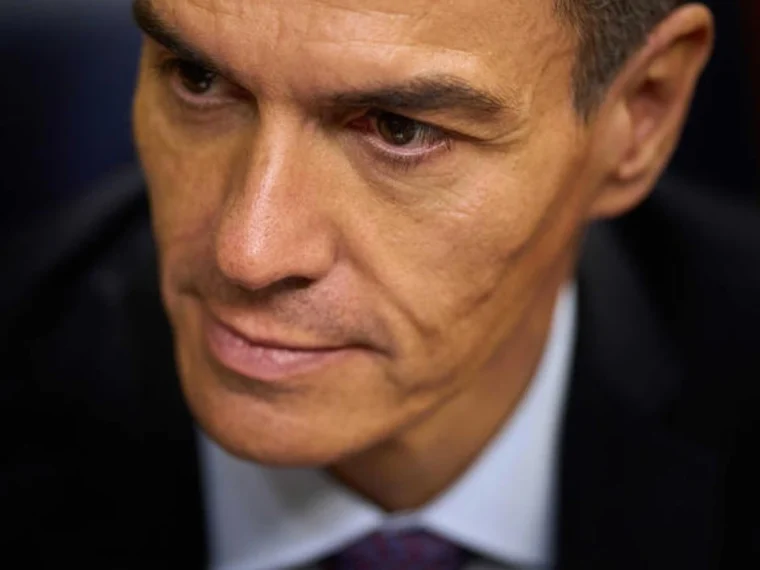
Spain’s prime minister Pedro Sánchez has become one of Europe’s strongest voices opposing U.S. President Donald Trump, especially after refusing to allow American forces to use Spanish military bases for operations linked to attacks on Iran.
The disagreement escalated this week when Trump criticized Spain’s decision and warned that the United States could “cut off all trade with Spain.” The comment intensified an already tense diplomatic exchange between the two allies.
Spain’s foreign minister further challenged the U.S. position after the White House claimed Madrid had understood Trump’s message “loud and clear” and was cooperating with American military efforts. Spanish officials clarified that the country had not agreed to support such operations.
Although Sánchez has criticized the authoritarian government in Tehran, he made it clear that Spain would not support what he described as an unjustified military conflict.
“We are not going to be complicit in something that is bad for the world and contrary to our values and interests, just because of fear of retaliation,” Sánchez said during a recent speech, repeating the slogan “No to the war.”
Tensions over military bases
The dispute centers on the use of American military bases located in Spain. While the United States maintains several bases across Europe and the Middle East, and many allies have cooperated with Washington, Spain has chosen a more cautious stance.
Relations between Madrid and Washington have historically been stable. The partnership dates back to the 20th century, when the United States began sharing military bases with Spain during the rule of dictator Francisco Franco.
However, the latest disagreement highlights growing political differences between Sánchez and Trump.
A progressive leader in Europe
Since first becoming prime minister in 2018, Sánchez has emerged as one of Europe’s most prominent left-leaning leaders. His government has strongly supported progressive policies, including gender equality, immigration reforms, human rights protections and climate action.
Many of these issues directly clash with the conservative ideology promoted by Trump’s political movement, often referred to as the Make America Great Again movement.
Calls for peace in Gaza
Beyond the Iran conflict, Sánchez has also been outspoken about the ongoing war in Gaza Strip. He has sharply criticized Israel for the high number of civilian casualties following the 2023 attacks by Hamas.
Sánchez has argued that the scale of destruction in Gaza goes far beyond self-defense and has urged the international community to pursue diplomatic solutions.
Disagreement within NATO
Another area of conflict involves defense spending within the NATO alliance. Spain was the only NATO member to refuse a proposal to increase military spending to 5% of national GDP.
Instead, Sánchez negotiated an exemption, stating Spain would maintain defense spending at about 2.1%, which he called a realistic level for the country.
Trump responded by suggesting that Spain could even face removal from NATO, though the idea has not progressed beyond rhetoric.
A different approach to immigration
Spain has also taken a notably different stance on immigration compared with many Western countries. While several European governments tightened border controls, Spain has been moving forward with plans to grant residency and work permits to roughly half a million migrants already living in the country.
Sánchez has frequently pointed to Spain’s economic growth as evidence that migration can strengthen, rather than weaken, a nation.
Regulating social media use
Under Sánchez, Spain has also joined countries like Australia and France in exploring stricter rules for teenagers’ use of social media platforms.
The proposal would prevent children under 16 from opening social media accounts, a move that drew criticism from tech leaders including Elon Musk, owner of the platform X.
Despite the backlash, Sánchez has defended the policy as necessary to protect young people online.
As geopolitical tensions rise and ideological divisions deepen, Sánchez has increasingly positioned himself as one of the most outspoken European critics of Trump’s foreign policy decisions.