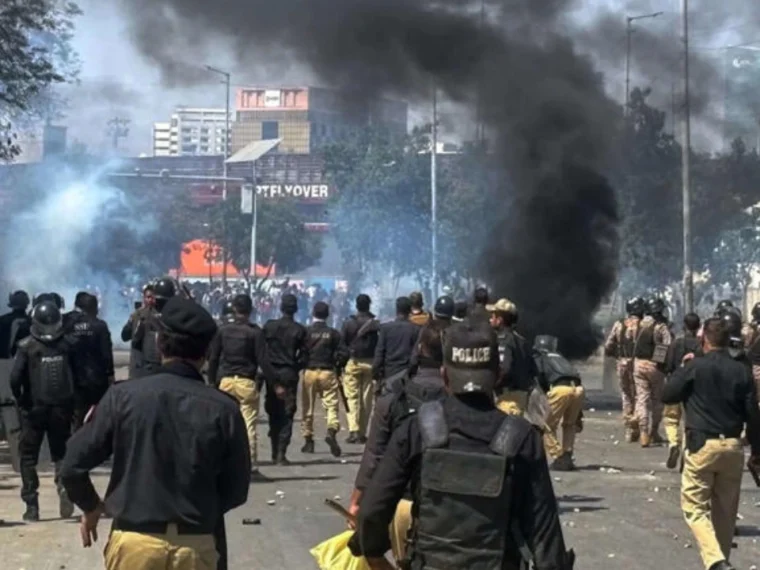
At least 22 people were killed and more than 120 others injured on Sunday as violent protests broke out across Pakistan, with demonstrators attempting to storm the U.S. Consulate in Karachi and attacking government and U.N. offices in the country’s north.
The unrest followed U.S. and Israeli strikes on Iran that reportedly killed Iranian Supreme Leader Ayatollah Ali Khamenei, triggering outrage among sections of Pakistan’s Shiite community.
Clashes in Karachi
In Karachi, Pakistan’s largest city and capital of Sindh province, protesters gathered near the U.S. Consulate, with some attempting to breach its perimeter. According to senior police official Irfan Baloch, demonstrators briefly attacked the outer boundary before being pushed back by security forces.
Authorities confirmed that at least 10 people died in Karachi. Summaiya Syed Tariq, a police surgeon at the city’s main government hospital, reported that several critically injured individuals later succumbed to their wounds. More than 50 people were injured in the city alone, some in critical condition.
Although officials denied reports that the consulate building was set on fire, they confirmed that protesters torched a nearby police post and smashed windows at the diplomatic compound before security regained control.
Violence in Gilgit-Baltistan
In the northern Gilgit-Baltistan region, clashes proved even deadlier. Local police official Asghar Ali stated that 12 people were killed and over 80 wounded when thousands of demonstrators attacked offices of the U.N. Military Observer Group and the United Nations Development Programme (UNDP).
Government spokesperson Shabir Mir said staff members from international organizations were safe, but protesters damaged public property, including police buildings and a local charity office. Troops were deployed to restore order, and authorities later claimed the situation had been brought under control.
Political Reaction
President Asif Ali Zardari expressed “profound sorrow” over Khamenei’s death and extended condolences to Iran. In an official statement, he said Pakistan stood in solidarity with the Iranian people during their time of grief.
Interior Minister Mohsin Naqvi appealed for calm, calling the day one of mourning for the Muslim world. However, he urged citizens not to take the law into their own hands and to keep demonstrations peaceful.
Protests Spread Nationwide
In Islamabad, police fired tear gas and used batons to disperse hundreds of protesters attempting to march toward the U.S. Embassy located inside the Diplomatic Enclave. Additional security forces had already been deployed in anticipation of unrest.
Similar scenes unfolded in Peshawar, where thousands attempted to approach the U.S. Consulate, prompting police to use tear gas to prevent escalation.
In Lahore, clashes were reported near the U.S. Consulate, while a peaceful rally took place in Multan, where demonstrators chanted slogans condemning the United States and Israel.
The U.S. Embassy in Pakistan said it was closely monitoring the situation and advised American citizens to avoid large gatherings, stay alert, and keep their travel registrations updated.
Heightened Security
Authorities confirmed that security has been significantly increased around U.S. diplomatic missions across Pakistan to prevent further violence. Police and paramilitary Rangers were stationed in large numbers outside consulates and the embassy.
Shiites constitute roughly 15% of Pakistan’s 250 million population and represent one of the largest Shiite communities globally. While anti-U.S. and anti-Israel protests have occurred in the past, officials noted that violence on this scale remains rare.
As tensions continue to simmer, the government has urged restraint, emphasizing the need for peaceful expression while maintaining law and order nationwide.