AGI
The internet often erupts whenever someone claims that Artificial General Intelligence (AGI) has arrived—and this time was no exception. A recent comment by Jensen Huang during a conversation on the Lex Fridman Podcast reignited the debate. Huang casually stated, “I think we’ve achieved AGI,” a remark that quickly sparked widespread discussion across tech communities and social media.
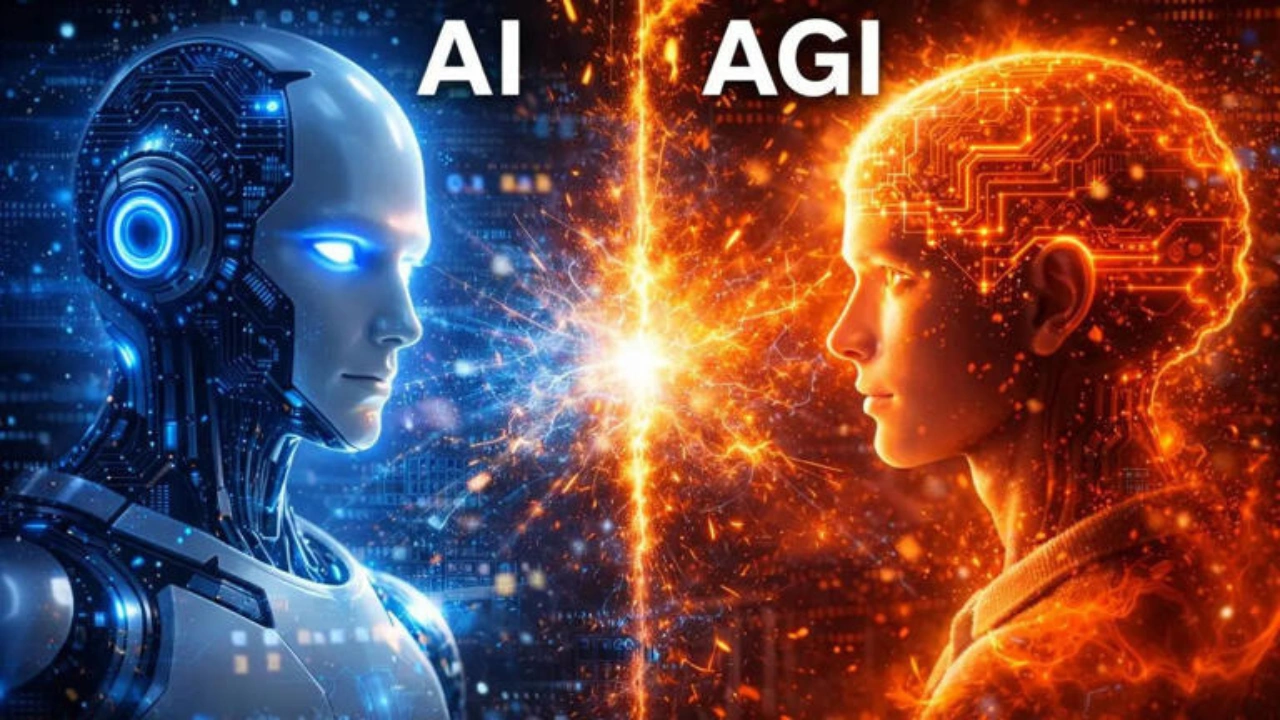
But the statement also brought back a fundamental question: what exactly qualifies as AGI, and how is it different from the artificial intelligence (AI) we use today?
What Is AGI?
Artificial General Intelligence, commonly referred to as AGI, represents a future stage of machine intelligence where systems can perform a wide variety of tasks with human-like understanding and flexibility. Unlike current AI systems that specialize in specific functions, AGI is envisioned as a more adaptable form of intelligence.
In simple terms, AGI would be capable of:
- Learning new skills without retraining from scratch
- Understanding context across different domains
- Solving unfamiliar problems
- Applying knowledge from one area to another
For example, an AGI system could write code, develop business strategies, analyze data, and even adapt to entirely new situations—much like a human.
How Is AGI Different from AI?
Most of the technology we use today falls under what experts call “narrow AI.” These systems are designed to perform specific tasks efficiently but lack the ability to think beyond their defined scope.
Here’s a clear breakdown:
| Aspect | Artificial Intelligence (AI) | Artificial General Intelligence (AGI) |
|---|---|---|
| Definition | Task-specific intelligent systems | Human-like general intelligence |
| Capability | Limited to one domain | Works across multiple domains |
| Learning | Based on training data | Learns and adapts independently |
| Flexibility | Cannot transfer knowledge easily | Can apply knowledge across tasks |
| Status | Widely available today | Still theoretical |
For instance, AI can recommend movies, translate languages, or assist with voice commands. However, if asked to switch roles or handle completely unrelated tasks, it often struggles. AGI, on the other hand, aims to remove these limitations.
A Shift in Definition?
When Jensen Huang spoke about AGI, he introduced a slightly different perspective. Instead of focusing purely on human-like intelligence, the discussion leaned toward capability and output.
He suggested that if an AI system can effectively run or build a billion-dollar company, it might already qualify as AGI. This interpretation shifts the focus from how machines think to what they can achieve.
However, this view is not universally accepted.
Experts Remain Divided
Many leading researchers believe that true AGI is still far from reality. Pioneers like Geoffrey Hinton, Yann LeCun, and Yoshua Bengio argue that AGI must match or surpass human intelligence across nearly all cognitive tasks.
Similarly, Demis Hassabis has pointed out that current AI systems still struggle with long-term planning, reasoning, and continuous learning. He estimates that AGI could take another five to eight years, provided major breakthroughs occur.
On the other hand, Elon Musk has suggested a much shorter timeline, predicting that AGI could emerge within the next few years. These contrasting views highlight just how uncertain the timeline remains.
Where Do We Stand Today?
Modern AI has made remarkable progress. It can generate human-like text, write code, analyze complex data, and even hold conversations. These capabilities would have seemed unimaginable just a few years ago.
However, despite these advancements, today’s AI systems still lack true understanding and independent reasoning. They operate based on patterns and data rather than genuine comprehension.
This is why many experts argue that we are still in the era of advanced AI—not AGI.
The Bigger Picture
The ongoing debate around AGI is less about technology and more about definition. There is no universally agreed standard for what constitutes AGI, which makes it easier for interpretations to vary widely.
Some define AGI based on capability, while others focus on human-like reasoning and adaptability. Until there is a clear consensus, claims about achieving AGI will continue to spark debate rather than settle it.
The conversation around AGI sits somewhere between hype and reality. While companies continue to push the boundaries of what AI can do, true general intelligence remains an open challenge.
Whether we are close to AGI or still years away depends largely on how we define it. And for now, that definition is still evolving—keeping the debate very much alive.
About the Author