Boiling Eggs
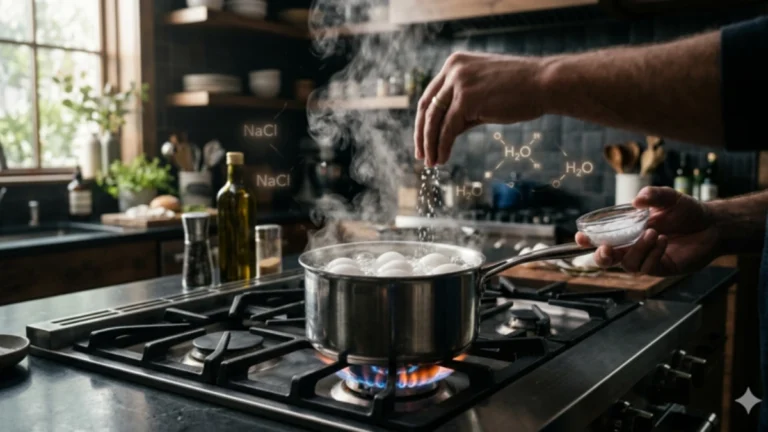
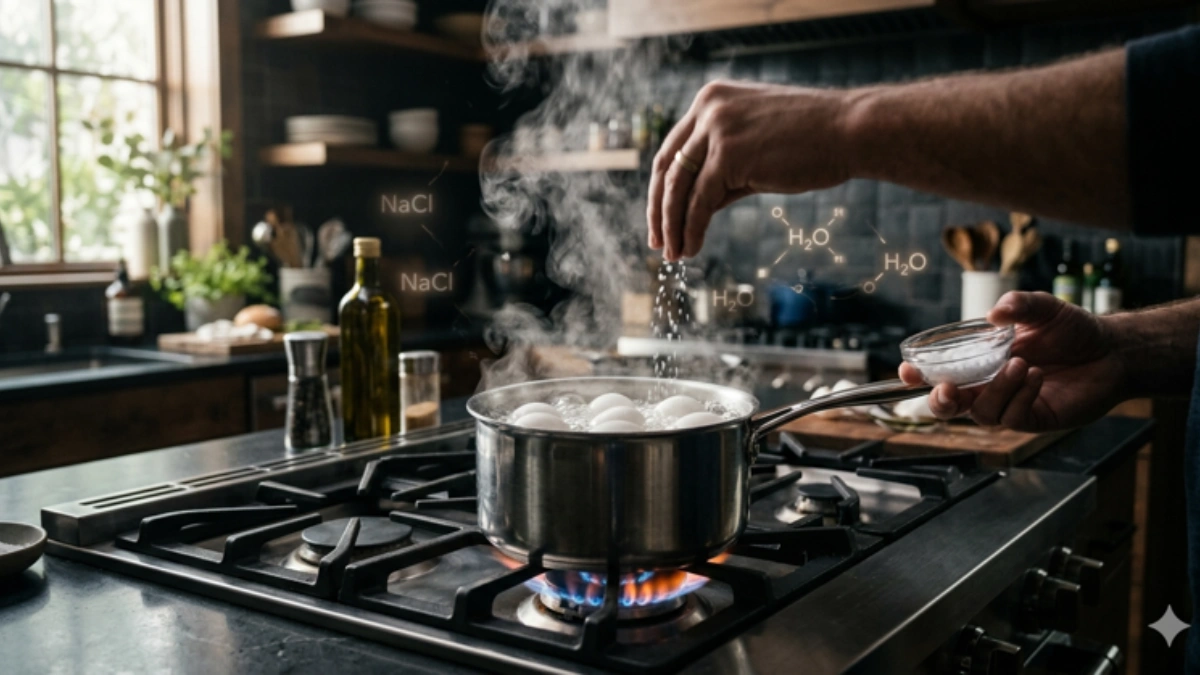
For decades, home cooks have followed a familiar ritual—adding salt to water before boiling eggs. It feels like an essential step, often passed down through generations as “kitchen wisdom.” But according to modern food science, this practice may not be as useful as many believe.
Recent discussions and controlled kitchen experiments suggest that adding salt to boiling water has little to no meaningful impact on how eggs cook, taste, or peel. While there is some scientific basis behind the idea, its practical benefits in everyday cooking are surprisingly minimal.
What Salt Actually Does to Water
Salt, or sodium chloride, does slightly alter the properties of water. When dissolved, it increases the boiling point and changes the density and ionic composition of the liquid.
Under laboratory conditions, adding around 15–20 grams of salt per liter of water can raise the boiling point by about 0.5°C. While this is measurable in a scientific setting, it’s almost irrelevant in a real kitchen.
Factors like stove heat fluctuations, pot material, and timing variations easily overshadow such a tiny temperature difference. In simple terms, your eggs won’t cook any differently just because the water is salted.
Some studies also suggest that salt may slightly improve heat transfer due to dissolved ions. However, repeated cooking experiments comparing salted and unsalted water show nearly identical results. Eggs set the same way, and their texture remains unchanged.
The Myth of Seasoning Eggs While Boiling
One of the most common beliefs is that salt in water helps season the eggs from the outside. But this idea doesn’t hold up scientifically.
Eggs are protected by a shell and inner membranes that are only semi-permeable. During the typical boiling time of 10–12 minutes, almost no salt penetrates inside the egg.
This means the taste remains virtually the same, whether you boil eggs in salted water or plain water. Even experienced tasters struggle to tell the difference. True seasoning only happens after cooking—when salt is added directly to the egg or used in dishes like egg salad or deviled eggs.
When Salt Can Actually Help
There is one situation where adding salt might make a visible difference. If an egg cracks during boiling, salt can help the leaking egg white coagulate faster.
This happens because the ionic environment created by salt speeds up protein coagulation when exposed to heat. As a result, the leaking white may form a seal around the crack, reducing further spillage.
However, this benefit is limited. With careful handling and proper cooking techniques, eggs rarely crack in the first place. So, while salt can help in this scenario, it’s more of a backup trick than a necessity.
It’s also worth noting that salt does not make eggs easier to peel—a widely believed myth. Peeling success depends more on factors like egg freshness and cooling methods.
What Experiments Reveal
Controlled kitchen experiments consistently show that eggs boiled in salted and unsalted water turn out almost identical. Any small differences observed usually fall within normal cooking variations, such as egg size or slight temperature changes.
This highlights an important point: while salt does create minor molecular changes, they are too small to affect everyday cooking results in any noticeable way.
Backed by Food Science
The science behind this topic is supported by broader research on protein behavior. Studies, such as those published by the University of Wisconsin–Madison in the Journal of Dairy Science, explain how sodium ions can influence protein structure and coagulation.
Food expert Harold McGee has also discussed how salt interacts with egg white proteins. While it can speed up coagulation under certain conditions, he notes that this doesn’t make it essential for boiling eggs.
What Actually Matters When Boiling Eggs
If you want perfectly boiled eggs, there are far more effective techniques than adding salt:
- Start eggs in gently heated water to reduce cracking
- Cool them quickly in cold or ice water to stop overcooking
- Use slightly older eggs for easier peeling
These methods are consistently recommended by both chefs and food scientists, making them far more reliable than adding salt to the pot.
A Tradition Worth Rethinking
Adding salt to boiling water may feel like a crucial step, but in reality, it’s mostly symbolic. While it does cause minor chemical changes, these rarely translate into noticeable improvements in your eggs.
In the end, perfect boiled eggs depend more on timing, temperature control, and technique—not on whether you add a pinch of salt.
About the Author