
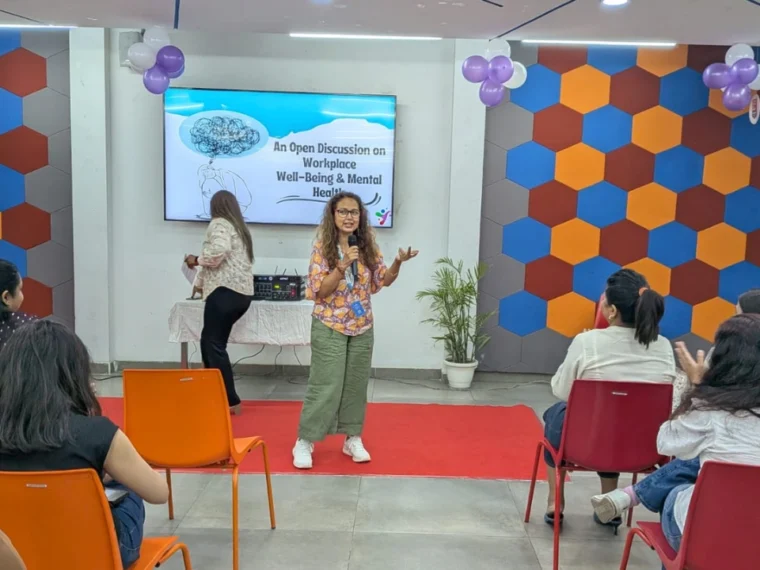
Noida: As conversations around employee well-being gradually gain momentum in corporate India, mental health advocates say workplaces must move beyond productivity metrics and start paying serious attention to emotional and psychological health.
Life coach and workplace well-being speaker Coach Veena recently conducted two interactive sessions on mental health and stress management for employees at Innova Solutions in Noida. The sessions, organised across two shifts to accommodate employees’ schedules, focused on workplace well-being, emotional resilience, and practical tools to deal with stress.
Despite their demanding work schedules, employees actively participated in the discussions, raising questions about career pressure, family expectations, and the challenges of maintaining a healthy work-life balance.
According to Coach Veena, the enthusiasm and openness shown by employees reflected a growing need within corporate environments to openly discuss mental health issues.
“Many organisations focus heavily on targets, deadlines and profit-making, but very few invest in the mental well-being of their employees. That is why it was encouraging to see employees engaging so openly in these conversations,” she said.
During the sessions, participants discussed several social and psychological factors affecting professionals today, particularly among younger employees and working women.
One of the key topics that emerged during the discussion was the career choices of women in modern households. While Coach Veena initially encouraged women to continue working throughout their careers to maintain financial independence and professional identity, some participants pointed out that a section of women voluntarily choose not to work after marriage and prefer a more comfortable lifestyle supported by their spouse’s income.
The discussion evolved into a deeper reflection on identity, independence and long-term emotional well-being.
According to participants, women who step away from their careers for comfort may initially enjoy the freedom from professional responsibilities. However, some eventually experience frustration due to a loss of personal identity or dependence on their partner for financial decisions.
“Several employees shared that over time, such dependency can create discomfort when spending choices are questioned or when individuals feel they have lost their sense of independence,” Coach Veena noted.
Another major theme that resonated strongly with employees was the mental health struggles faced by Generation Z professionals entering the workforce.
Many younger employees expressed that feelings of anxiety, stress and emotional burnout often stem from pressures built during their formative years. According to them, parental expectations, academic pressure and societal comparisons have played a significant role in shaping their mental health.
Some participants suggested that parents, often unintentionally, pass on their own anxieties and unfulfilled ambitions to their children, which later manifests as stress and emotional trauma in adulthood.
Coach Veena acknowledged the concern and emphasised the importance of emotional awareness within families as well as workplaces.
“Gen Z is far more open about discussing mental health compared to earlier generations. Instead of dismissing their concerns, we need to understand the root causes of their anxiety and help them develop healthy coping mechanisms,” she said.
As part of the workshop, Coach Veena also introduced employees to several somatic tools—body-based techniques designed to regulate stress and improve emotional resilience. These methods help individuals become more aware of their physical responses to stress and use breathing, grounding and mindfulness techniques to calm the nervous system.
Participants also discussed the difference between positive and negative coping mechanisms.
Coach Veena explained that while stress is a natural part of professional life, the way individuals respond to it determines long-term mental health outcomes.
She warned against unhealthy coping habits such as binge eating, excessive online shopping driven by emotional triggers—often referred to as “trauma shopping”—and alcohol consumption.
“These behaviours may provide temporary relief, but they do not solve the underlying problem. In fact, they often worsen stress over time,” she said.
Instead, she encouraged employees to adopt healthier strategies such as mindful breathing, physical movement, open communication and setting personal boundaries in both professional and personal life.
Corporate mental health experts believe such initiatives are becoming increasingly important as workplaces evolve and younger generations enter the workforce with different expectations around well-being and work culture.
The sessions at Innova Solutions were coordinated with the support of Shilpa Rajpoot, who facilitated the initiative as part of the organisation’s employee engagement efforts.
Coach Veena said the experience reinforced the importance of creating safe spaces in workplaces where employees can openly talk about stress, emotional challenges and personal growth.
“Conversations like these help employees realise they are not alone in their struggles. When organisations prioritise well-being, it ultimately leads to healthier and more productive workplaces,” she said.
With corporate burnout becoming a global concern, experts say structured mental health programs, counselling sessions and well-being workshops may soon become an essential part of organisational culture rather than an optional initiative.
Coach Veena expressed hope that more companies will recognise the value of investing in employee well-being and organise similar workshops in the future.
“I look forward to conducting more workplace well-being sessions and continuing the dialogue around mental health in corporate environments,” she said.