
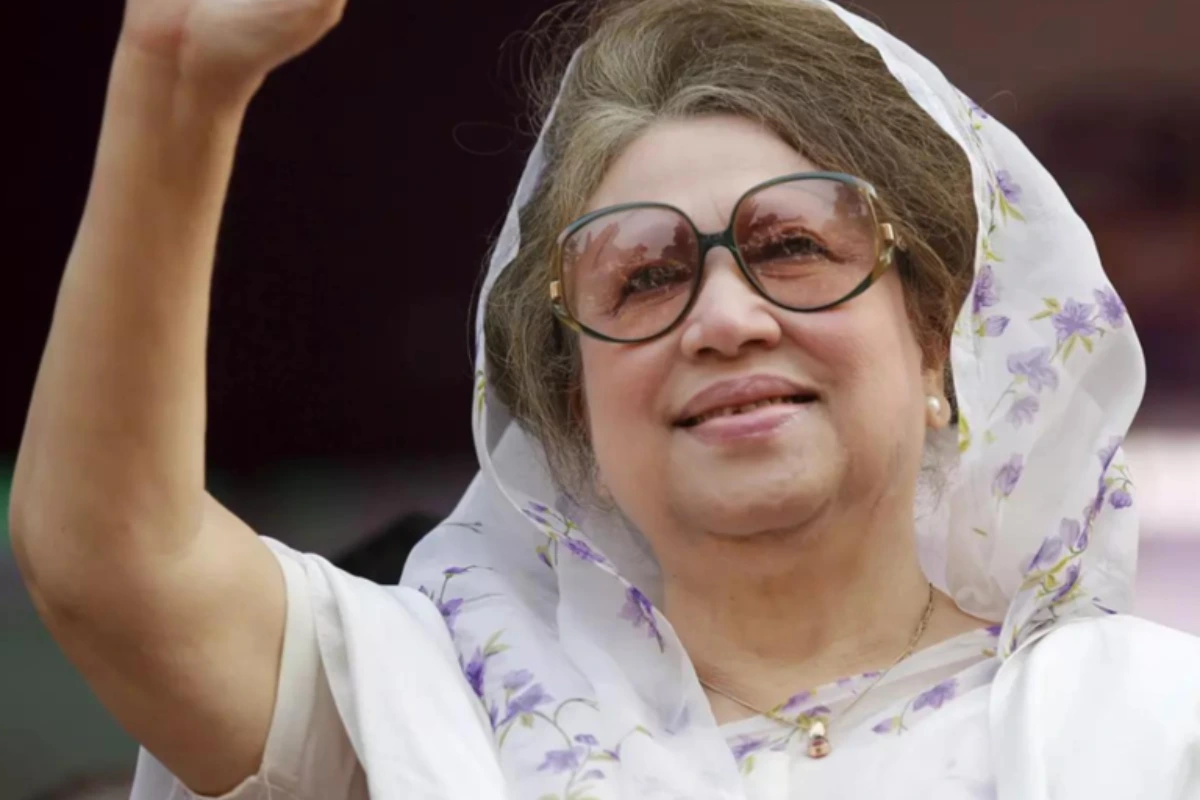
Former Bangladesh prime minister and Bangladesh Nationalist Party (BNP) chief Khaleda Zia died on Tuesday at the age of 80, her party confirmed. A towering figure in the country’s politics, her decades-long rivalry with Sheikh Hasina played a defining role in Bangladesh’s modern political history.
According to the BNP, Khaleda Zia passed away around 6:00 am, shortly after the Fajr (dawn) prayer. Party leaders and supporters expressed deep grief, urging people across the country to pray for her departed soul.
Despite prolonged illness and years of legal battles, Khaleda Zia remained politically relevant till the end. In November, she had indicated her intention to campaign in the general elections scheduled for February 2026, following Sheikh Hasina’s removal from power last year.
Her health had deteriorated significantly in late November due to multiple medical complications, leading to her hospitalisation. Interim leader Muhammad Yunus described her as a “source of inspiration for the nation,” acknowledging her influence on Bangladesh’s democratic journey.
Early Life and Political Rise
Khaleda Zia was born on August 15, 1945, in Jalpaiguri, located in the then undivided Dinajpur district of British India, now part of West Bengal. She entered national politics after her husband, Ziaur Rahman, assumed the presidency in 1977. His assassination during a military coup in 1981 marked a turning point in her life.
Following his death, Khaleda Zia emerged as a key political leader and played a central role in the mass movement against military rule. The movement culminated in the fall of dictatorship in 1990, restoring democracy to Bangladesh.
Political Career and Controversies
Khaleda Zia became Bangladesh’s first woman prime minister in 1991, serving until 1996. She returned to office in 2001 and remained in power until 2006. Her second term, however, was marred by allegations of corruption, with Bangladesh ranking poorly on global corruption indices during that period.
Political instability after her tenure led to a military-backed caretaker government. In 2018, she was imprisoned on corruption charges during Sheikh Hasina’s rule, which she consistently described as politically motivated.
Her health worsened in custody, and she was shifted to hospital care in 2019 before being released under house arrest on humanitarian grounds. In November 2024, the Supreme Court acquitted her in the final corruption case, reviving hopes of her political return.
Earlier this year, Khaleda Zia returned to Bangladesh after medical treatment in the United Kingdom, following approval from the interim government.
Family and Legacy
Khaleda Zia is survived by her elder son, Tarique Rahman, the acting chairman of the BNP, who recently returned to Bangladesh after 17 years in self-imposed exile. He is expected to lead the party into the February 12 general election and could become prime minister if the BNP secures victory.
Her younger son, Arafat Rahman “Koko,” died in 2015 due to a heart attack. Several members of her family, including her sister Khurshid Jahan and brother Sayeed Iskander, were also associated with politics.
Inputs from agencies