
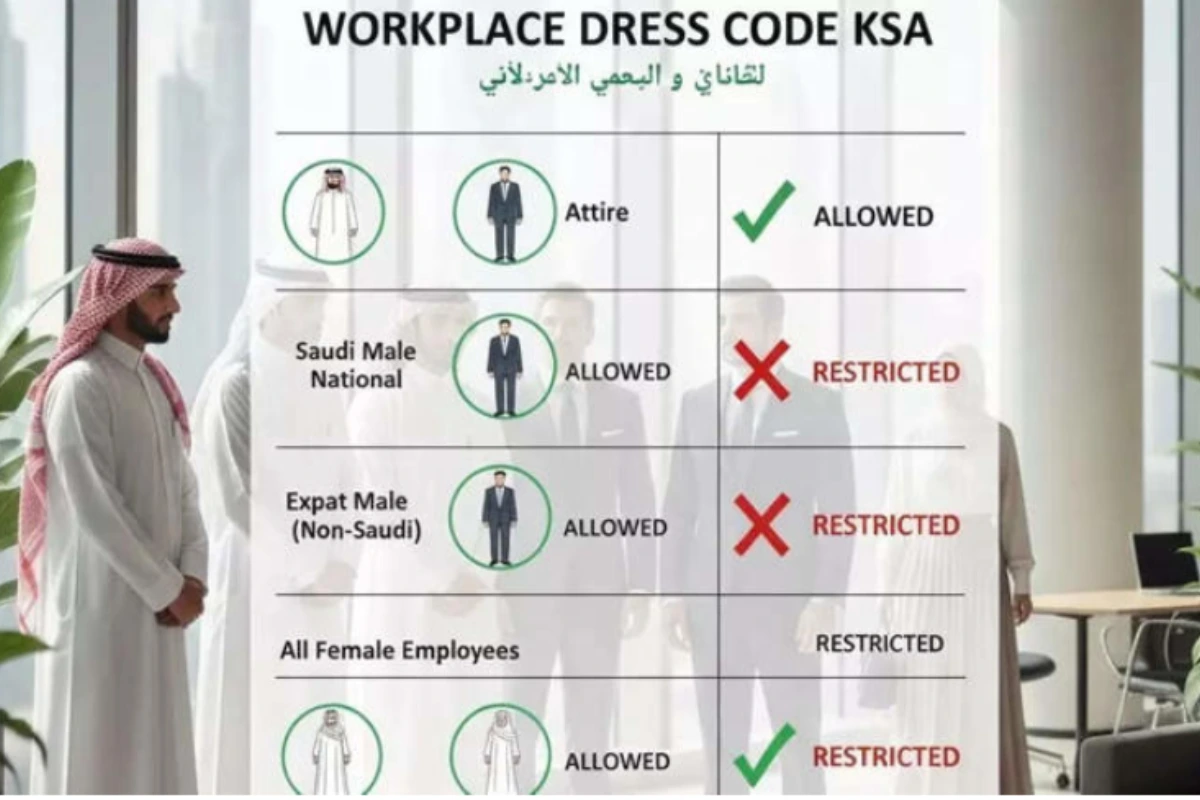
Saudi Arabia has unveiled a draft “Code of Appearance and Conduct” outlining strict dress and behaviour guidelines for employees across the public, private, and non-profit sectors. Released by the Ministry of Human Resources and Social Development (MHRSD), the proposal is currently open for public feedback and aims to create a professional, culturally aligned corporate environment nationwide.
The new framework sets detailed expectations for how Saudi and non-Saudi employees should present themselves at work. For Saudi men, the draft clearly requires the traditional national dress — the thobe along with the ghutra or shemagh. This mandatory attire is intended to reinforce cultural identity and maintain a uniform professional appearance.
For expatriate male employees, the rule specifies the formal business suit, removing ambiguity around acceptable workplace clothing and establishing a consistent standard of formality for foreign staff.
The guidelines also outline clear expectations for women. Both Saudi and non-Saudi female employees must wear modest clothing that fully covers the body and is neither tight-fitting nor transparent. These standards apply to regular office work as well as any official events, media appearances, or public-facing assignments related to their job roles.
Beyond clothing, the draft covers professional conduct and general appearance. Employees must maintain personal hygiene, adhere to respectful behaviour, and avoid wearing accessories or items displaying political, ideological, or offensive symbols.
Under the proposal, employers are required to implement and visibly display their own internal dress code aligned with the national regulation. Failure to do so — or failure to enforce it — can result in penalties, with fines historically reaching up to SR 5,000 under Saudi labour laws.
The draft signals the Kingdom’s intention to strengthen workplace discipline and promote a unified professional identity. While the final details may change based on public consultation, the overall direction suggests a more structured, standardised corporate culture is on the horizon.